Why Workforce Data Matter
Home visiting workforce data provide crucial insight into what it takes to build and maintain a high-quality home visiting system that supports children and families. Program administrators, policymakers, and funders can use metrics like workforce supply, characteristics, and demand to inform funding needs, improve professional development, reduce turnover, and increase the number of people entering the workforce.
What the Dashboard Includes
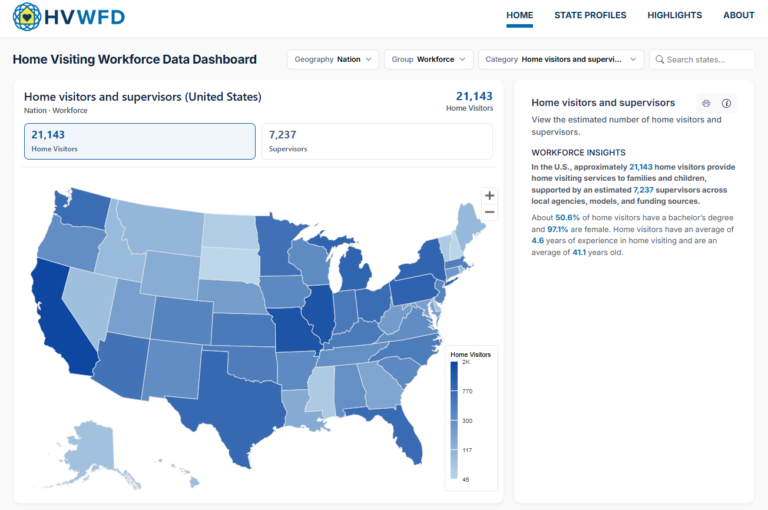
The Home Visiting Workforce Data Dashboard is the only resource of its kind providing data on the home visiting workforce regardless of model or funding source. The 2026 Dashboard includes results from data collection with 29 home visiting models, the Institute for the Advancement of Family Support Professionals, the National Home Visiting Resource Center’s 2026 Home Visiting Yearbook, and public-use files to provide key metrics at the national, state, and county levels. These include:
- Number of home visitors and supervisors
- Home visitor age, sex, work experience, and education level
- Workforce trends in similar fields, including early childhood education, nursing, social work, and public health
The Dashboard uses information currently available on the home visiting workforce but reflects limitations associated with data availability. Our data may underestimate the number of home visitors and home visiting supervisors. In future years, we will expand the Dashboard, working with models and partners to improve data availability and provide a more complete picture of the workforce.
- Number of home visitors and supervisors
- Home visitor age, sex, work experience, and education level
- Ratio of available home visitors to households with young children or pregnant women
- Workforce trends in similar fields, including early childhood education, nursing, social work, and public health
Who Can Use the Dashboard
Home visitors and supervisors can use the Dashboard to demonstrate their role within early childhood support systems, and inform discussions about staffing needs, workload, and resource allocation.
Local programs can target expansion efforts by identifying counties with high demand for home visiting services.
State administrators can compare workforce characteristics in their state to those in other states or nationally.
System leaders can better understand characteristics of the existing workforce to inform workforce pipelines and enhance career pathways.
How to Use the Dashboard
Visit the Dashboard’s Home page to explore national, state, and county data on the workforce, households that may benefit, and similar fields. Click the State Profiles tab to view and print key data by state. Click the Highlights tab to see key takeaways from the 2026 Dashboard or the About tab to discover sample areas of exploration and step-by-step instructions.